

On October 17, Matti Leppäranta, an internationally renowned cryosphere research expert and professor emeritus at the University of Helsinki, was invited to give a special academic lecture. The lecture was presided over by Professor Su Jie, and teachers and students of the Polar Group of the School of Ocean and Atmosphere and relevant scientific researchers attended the meeting.
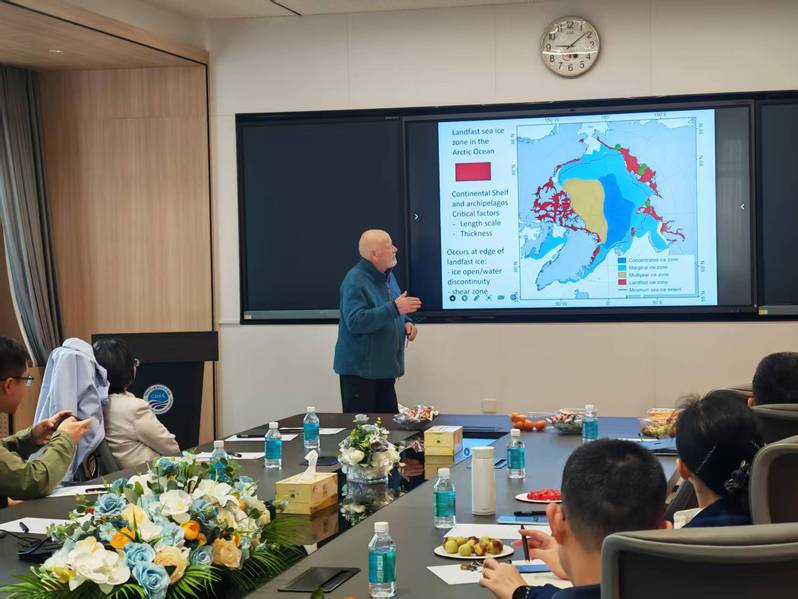
Professor Matti Leppäranta is an authoritative expert in the field of geophysics, with a master's degree in mathematics and a doctorate in physical oceanography from the University of Helsinki, and has worked at the Finnish Institute of Oceanography and a long-term professor at the University of Helsinki. He is the author of classic monographs in the fields of Sea Ice Drifting, Lake Freezing and Its Ice Sheet Evolution, and has accumulated profound attainments in combining field observation, remote sensing technology and mathematical modeling to study the physical processes of ice sheets.
The theme of this lecture is Landfast sea ice in sea ice research and modelling, focusing on the scientific problems and modeling challenges of landfast sea ice in sea ice research and simulation. Professor Leppäranta pointed out that continental margin ice is the first zone of sea ice that extends from the continent to the polar ocean, and its activity is low, with some movement only at the beginning of ice formation and at the end of ablation. Due to the topographical constraints of islands and stranded ice ridges in coastal areas, the movement of continental edge ice is significantly limited, so 2D ice strength has become a key factor in determining the stability of continental edge ice. In terms of model studies, continental margin ice is often reduced to fixed boundaries or treated by semi-empirical parameterization methods. However, due to the complex coastal topography, ocean currents, and multi-scale coupling characteristics of sea ice dynamics, the numerical simulation of this problem is still very challenging and has not been fully solved. Professor Leppäranta analyzed the key challenges in continental margin ice modeling with rigorous physical derivation and emphasized its importance in understanding polar climate systems.
In the second part of the lecture, Prof. Leppäranta introduced the method of dimensional analysis Classic application in the study of physical problems. By identifying and simplifying the dimensional relationship of physical quantities, dimensional analysis enables researchers to discover the eigenscale and key control parameters in the problem, so as to extract first-order approximate solutions and basic physical laws in complex systems. He used the Reynolds number in fluid mechanics as an example to show how to reveal the similarity principle and control mechanism of the system by constructing dimensionless variables. In particular, Professor Leppäranta pointed out that dimensional analysis is not only a basic tool in physics, but also an important method for training scientific thinking. For graduate students, mastering dimensional analysis methods can help cultivate systematic scientific thinking ability and understand the internal connection between different physical quantities, so as to have a more solid foundation and logical judgment in theoretical modeling, experimental design and data interpretation.
After the lecture, Professor Matti had an in-depth discussion with the teachers and students on the details of model application, technical difficulties in Arctic sea ice monitoring, and the direction of international cooperation, and patiently answered the questions raised by the teachers and students. On the same day, Professor Matti also visited the Polar Ocean Processes and Global Ocean Change Laboratory, providing valuable suggestions for the laboratory's related research work. As an important part of Professor Matti's four-day academic exchange in China, this lecture not only brought cutting-edge knowledge and technical perspectives in the field of cryosphere research to teachers and students, but also promoted the academic linkage between our university and relevant international teams in the field of sea ice observation and simulation, laying a solid foundation for deepening cooperative research in the future.