
On November 20, 2025, at the invitation of Ocean University of China (OUC), Associate Professor Igor L. Bashmachnikov from St Petersburg State University, Russia, delivered an academic lecture entitled Detection of deep underwater eddies at the sea-surface at the College of Oceanic and Atmospheric Sciences.
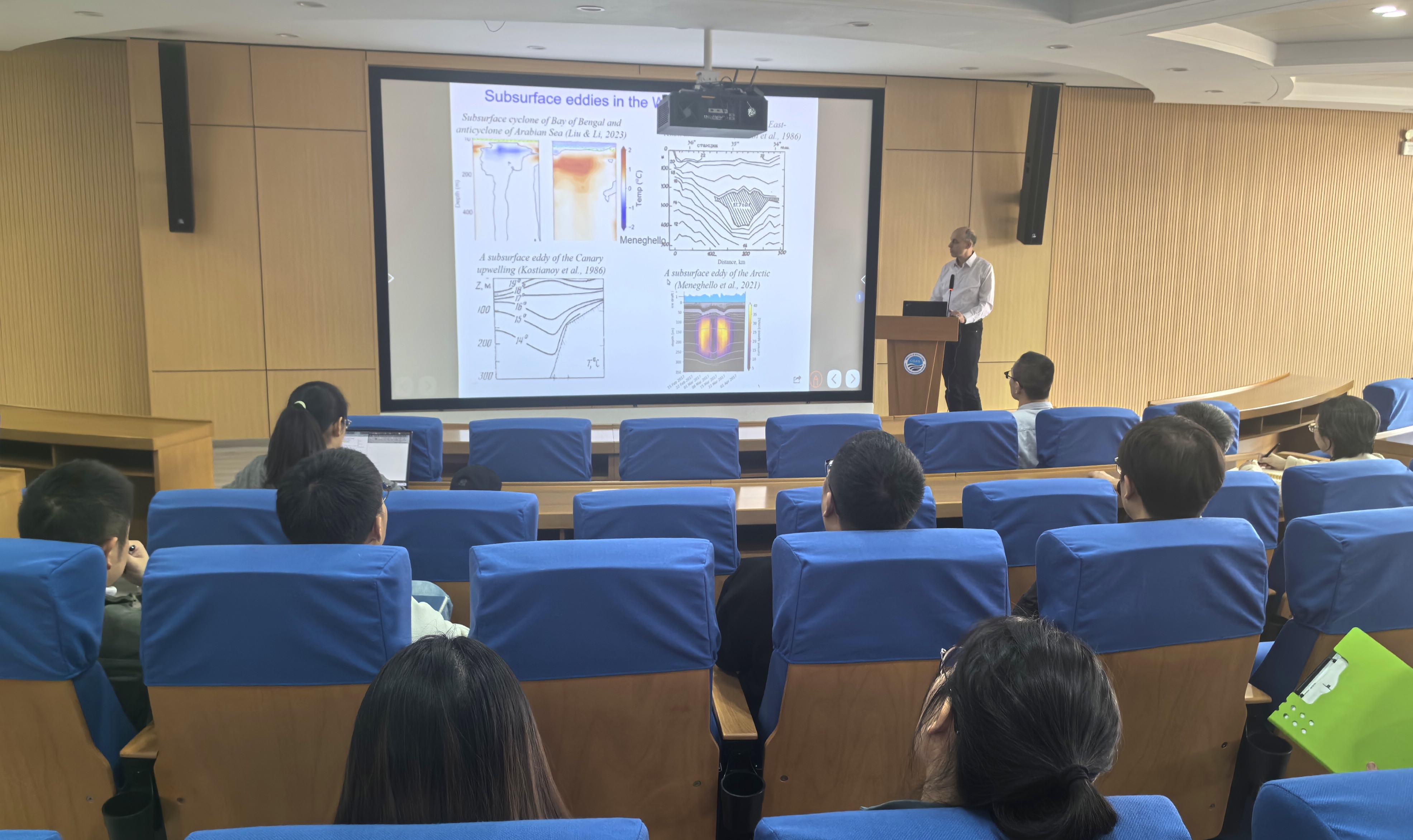
Dr. Bashmachnikov’s research shows that although the cores of some intense deep‑sea anticyclonic eddies (such as Mediterranean eddies, abbreviated as meddies) lie 500–1500 meters below the sea surface, they still generate distinct thermodynamic signals detectable at the surface.
These large meddies are typically accompanied by sea‑surface height anomalies of up to 15–20 cm and negative relative vorticity anomalies with a magnitude of 0.1 times the Coriolis parameter, known as meddy sea‑surface signals. These signals are not random phenomena; they form in the water column above meddies due to potential vorticity conservation and can persist for 3–12 months, making them trackable by satellite remote sensing over long periods.
Unlike surface anticyclonic eddies, such subsurface anticyclonic eddies usually manifest as negative sea‑surface temperature anomalies at the surface, surrounded by a ring of relatively warmer water. This feature arises from the uplift of isopycnals above the eddy core and the process of warm water enveloping the cold core. Upwelling induced at the eddy center is a key mechanism maintaining this structure.
These findings provide a new approach for retrieving deep‑ocean dynamic processes using satellite remote sensing data, and are of great significance for improving ocean eddy monitoring, understanding ocean energy transfer, and enhancing the accuracy of climate models.
Prior to the lecture, Igor Bashmachnikov held in‑depth academic exchanges with three researchers from POGOC. They discussed topics including polar ocean observations, sea‑ice and iceberg dynamics, and interdisciplinary data assimilation methods. The two sides also exchanged views on potential future cooperation in Arctic ocean energy transport, variability of ocean deep convection, and applications of artificial intelligence in marine remote sensing.